

Living in Bury St Edmunds (2026) — Area, Commuting, Schools & Moving Tips
Thinking of living in Bury St Edmunds and need to know more about it?
Our guide was designed for you in mind.
Some places just have a feeling about them. Step into Bury St Edmunds on a quiet Tuesday morning, and you will notice it immediately: the warm honey-stone of the Georgian facades, the hum of a twice-weekly market in full swing, the faint scent of something brewing courtesy of a famous local institution.
Suffolk’s only city carries its history lightly, wearing centuries of character without a trace of stuffiness.
It is a town where independent shops thrive, school gates buzz with community spirit, and the commuter question has a surprisingly manageable answer.
Whether you are considering your very first move or orchestrating a well-planned relocation, this guide covers everything you genuinely need to know about living in Bury St Edmunds in 2026.
Table of Contents
Living in Bury St Edmunds Article Overview
This quick overview highlights everything that matters, from property prices to lifestyle, so you can decide if it’s the right move:
- What Makes Bury St Edmunds Special
A historic Suffolk market town with a city title, known for its Abbey Gardens, cathedral, and strong community feel. - Property Market Snapshot (2026)
Average prices sit around £332,000, offering better value than the Southeast while still delivering quality homes and strong demand. - Commuting & Transport Links
Direct rail connections to Cambridge and Ipswich, plus London access in under 2 hours, make it viable for commuters. - Schools & Education
A solid mix of well-rated state and independent schools makes the area particularly attractive for families. - Lifestyle & Local Living
From bustling markets to festivals and green spaces, the town offers a lively yet relaxed way of life. - Cost of Living Overview
More affordable than London and nearby counties, with reasonable council tax and everyday living costs. - Moving Tips for the Area
Narrow streets, market days, and period properties require a bit of planning, especially on moving day.
Bury St Edmunds combines heritage, connectivity, and lifestyle in a way that’s hard to beat, making it a smart choice for movers in 2026.
Getting to Know the Town: What Makes Bury St Edmunds Special
Bury St Edmunds sits at the heart of West Suffolk, roughly equidistant between Cambridge and Ipswich. It carries the title of city thanks to its cathedral, yet in the best possible way it feels like an oversized market town, one with real depth.
The town’s centrepiece is the magnificent Abbey Gardens, developed on the ruins of one of medieval England’s most powerful Benedictine monasteries. It is six acres of beautifully tended space that locals use year-round for everything from morning dog walks to summer picnics.
Meanwhile, St Edmundsbury Cathedral, Suffolk’s only cathedral, anchors the skyline and remains a genuine focal point of community life.
For a full flavour of what the town has to offer, the team at Visit Suffolk have put together an excellent overview of Bury St Edmunds attractions and landmarks well worth a read before you arrive.
The town also punches well above its weight culturally. Theatre Royal is the only surviving Regency-era playhouse in Britain, now run by the National Trust.
There is a thriving independent cinema, a regular literary festival, and the Greene King Brewery, which has been crafting ale in the town centre since 1799.
The Property Market in 2026: What to Expect When Buying or Renting
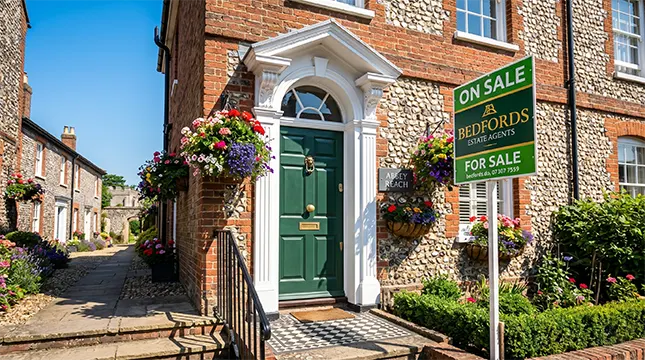
One of the first questions anyone researching a house move asks is what the property actually costs. To answer that, Bury St Edmunds sits at the more premium end of the Suffolk market, but compared to the counties further south it remains genuinely competitive for what you get.
According to recent Land Registry data compiled by Rightmove, the average sold price across the town sits at around £332,000, with terraced homes typically coming in under £325,000 and detached properties from £480,000 upwards. Flats represent better value for first-time buyers, often available from the mid-£100,000s in the right part of town.
Moreton Hall, to the east of the centre, is popular with families for its newer housing stock and proximity to good schools.
The town centre itself offers period properties with real character, while the Westgate and Abbeygate streets attract buyers who want to be within easy walking distance of everything.
Rental demand is healthy throughout the year, driven partly by a steady flow of professionals relocating for work.
Getting Around: Commuting from Bury St Edmunds in 2026

Connectivity is a genuine selling point for anyone worried about trading the city for a quieter setting.
Bury St Edmunds is on the Greater Anglia network, with regular departures to Cambridge and Ipswich, both of which offer onward connections across the country.
For London-bound commuters, the fastest services into Liverpool Street take around 1 hour 46 minutes via a single interchange, with trains departing from as early as 05:30 on weekdays.
Greater Anglia runs up to two services per hour at peak times, and advance fares can be surprisingly reasonable when booked ahead. You can check live timetables directly on the Greater Anglia website.
By road, the A14 provides quick access to Cambridge (roughly 30 minutes) and connects to the A11, A1, and the M11 for those driving further afield. Ipswich is about 30 miles via the A14, and the journey to Norwich is manageable in under 90 minutes on a clear run.
If you work locally, cycling is surprisingly viable, the town centre is compact and relatively flat for East Anglia.
Schools in Bury St Edmunds: A Practical Guide for Families

School provision in and around Bury St Edmunds is generally strong, and it is one of the factors that consistently draws families to the area.
The town follows a three-tier education system in parts, so it is worth understanding how primary, middle and upper schools are organised in West Suffolk before committing to a particular neighbourhood.
At the primary level, Abbots Green Primary Academy is rated Good by Ofsted and has built a positive reputation among local parents.
At secondary level, Priory School holds an Outstanding rating and operates as an all-through school, while King Edward VI C of E Upper School and Bury St Edmunds County Upper School serve the broader secondary intake.
Independent options include Culford School, just outside town, which caters from prep through to sixth form.
For a comprehensive comparison of all local schools, the School Guide is a useful starting point.
Families moving with children of different ages should check catchment boundaries carefully before choosing where to buy or rent as these can vary significantly street by street.
For further practical advice on relocating with younger family members, GoodMove’s guide on moving house with children covers the emotional as well as the logistical side of the process.
Life After the Move: Everyday Living and What to Look Forward To

One of the things people notice quickly after settling in Bury St Edmunds is just how full the social calendar can be. This is not a town that goes quiet at 6pm.
The markets run on Wednesdays and Saturdays; independent food producers are dotted across the town; and the cafe culture is genuine rather than manufactured.
Bury St Edmunds won Gold at the RHS Britain in Bloom competition, and strolling through the town in late spring with 500-plus hanging baskets in full colour is something most residents mention unprompted.
The annual food and drink festival, the literary festival held each October, and the racecourse at Newmarket, just 14 miles west, give the area a cultural variety you might not expect from a town of this size.
The Visit Suffolk guide to Bury St Edmunds rounds up ten of the highlights in one handy read.
For outdoor enthusiasts, the King’s Forest near Thetford, the River Lark corridor, and West Stow Country Park offer proper countryside within easy reach.
The town also holds the unofficial title of England’s Most Dog-Friendly Town, which tells you something about the community feel.
Cost of Living: Budgeting for Life in West Suffolk

Bury St Edmunds is not the cheapest option in Suffolk, but it delivers exceptional value when you compare it honestly with the southeast.
Everyday costs, supermarkets, utilities, and council tax are broadly in line with the wider region, and the combination of independent retailers and twice-weekly markets means savvy shoppers do very well.
West Suffolk Council tax in Band D for 2025/26 sits comfortably below the national average for English authorities.
Eating out locally caters to every budget, from market stalls to independently owned restaurants that regularly appear in regional food guides.
For those comparing the cost of renting versus buying in the area, Zoopla’s Bury St Edmunds house price tracker provides regularly updated figures to benchmark your planning.
If you are moving from London or the home counties, the financial case for relocating here is often very compelling.
Many people who make the jump find that a comparable property costs half what they were paying, freeing up income for the kind of lifestyle, good food, outdoor space, cultural events, that drew them to the idea of Suffolk in the first place.
Practical Moving Tips Specific to Bury St Edmunds
A few things are worth knowing before moving day arrives.
Bury St Edmunds town centre has some genuinely narrow streets, particularly around the Traverse and St John’s Street area, so if you are moving into or near the centre, it pays to discuss access with your removals company well in advance.
Parking restrictions and market day closures on Wednesdays and Saturdays can catch people out if they are not aware.
If you are moving into a period property, it is also worth factoring in time to assess furniture dimensions against doorways and staircases. Older buildings in the town centre can have some charming but narrow access points.
GoodMove’s article on moving large and awkward furniture has a very practical breakdown of how to handle this sort of challenge without expensive surprises on the day.
If there is a gap between leaving your old property and completing on the new one, something that happens regularly in a busy market, flexible storage is worth arranging in advance.
GoodMove offer both short and long-term storage solutions across the Suffolk region, keeping your belongings secure and accessible while the paperwork catches up. You can read more about bridging storage options in their guide on storage during a house move.
For families on the move with children, good preparation makes a significant difference.
If you would like further advice on making the day as smooth as possible for everyone in the household, GoodMove’s advice for moving home with pets and their packing tips guide are both worth bookmarking before the boxes come out.
Planning a Move to Bury St Edmunds? Make It a GoodMove

GoodMove Removals & Storage has been helping families and individuals relocate across Suffolk, Essex, Norfolk and beyond for over 35 years.
Based on the Essex and Suffolk border, the team knows this part of the country inside out and handles every move with a level of care that keeps clients coming back and recommending them to friends.
As a long-standing member of the British Association of Removers (BAR), GoodMove operates to the BAR Code of Practice, which means MoveProtect cover, an independent complaints process if you ever need it, and a fully trained team that treats your belongings as if they were their own. It is the kind of reassurance that matters on a day when there is already plenty to think about.
Whether you are moving locally within West Suffolk or coming in from further afield, GoodMove offers full and part-load removals, professional packing services, and flexible storage to bridge any gaps.
Free no-obligation quotes are available via the GoodMove website or by calling our office directly.
For removals to Bury St Edmunds and anywhere else in Suffolk, make it a GoodMove!
Frequently Asked Questions About Moving to Bury St Edmunds
How far in advance should I book a removal company when moving to Bury St Edmunds?
Ideally, you should start speaking to removal companies four to six weeks before your target moving date, and even earlier if you are planning a move during the summer months of June, July and August, when demand is at its highest. Booking early gives you a better choice of dates and allows time for a proper home survey, so nothing is left to guesswork on moving day.
Is it worth paying for professional packing services, or can I manage it myself?
That depends largely on how much time you have and what you are moving. Professional packers are particularly worthwhile for fragile or high-value items such as antiques, artwork, glassware or electronics. Many people opt for a hybrid approach, handling books and clothing themselves while leaving the more fragile or bulky items to the experts. A good removals company will offer both full packing and fragile-only services, so you can mix and match to fit your budget.
What should I do if my completion date changes at the last minute?
Speak to your removal company as soon as possible — the sooner they know, the more options they have to accommodate a date change. A reputable firm will do everything it can to adjust, though changes at very short notice may incur fees depending on the company’s policy. It is also worth asking about short-term storage solutions at the booking stage, as having a storage plan in place means a delayed completion does not have to derail your entire move.
Do I need to be present during the removal, or can someone else oversee it?
While it is strongly advisable to be present at both properties on moving day, it is not always possible. If you cannot be there in person, arrange for a trusted friend or family member to be on site to answer questions, sign off on the inventory, and hand over keys. Brief them thoroughly beforehand so they know exactly what is going, what is staying, and any access issues to be aware of such as parking restrictions or keypad codes.
What happens to my belongings if there is a delay between leaving my old home and moving into the new one?
This is where short-term storage comes in. Most reputable removal companies offer containerised storage facilities where your possessions can be safely held between moves. Your items are typically loaded into sealed containers, inventoried, and kept in secure, climate-controlled warehouses until you are ready for delivery. It is worth asking your removal company about this option at the quote stage and factoring the cost into your overall moving budget.
How do I protect myself if something gets damaged during the move?
The best protection starts with choosing a removal company that is a member of the British Association of Removers, as BAR-accredited companies are required to carry comprehensive liability insurance and operate under the BAR’s consumer protection framework, which includes MoveProtect cover. Before moving day, photograph high-value items and carefully read your company’s terms regarding damaged goods. If you have particularly valuable possessions, ask your removals company whether additional declared-value cover is available, and check whether your home contents insurance policy covers goods in transit.
What should I declutter before moving house?
Anything you no longer use, need, or want. Moving is the perfect opportunity to reduce volume, cut costs, and avoid packing items that will just sit in boxes in your new home.